
This blog is about the rise and fall of the greatest empires in history. Throughout history, great empires have shaped the world through their military power, economic strength, cultural achievements, and political influence. These empires expanded across vast territories, introduced new systems of governance, and left behind remarkable legacies that continue to influence modern civilization. While some empires lasted for centuries, many eventually declined due to internal weaknesses, economic challenges, political instability, or external invasions. Studying the rise and fall of these great empires helps us understand how civilizations grow, prosper, decline, and eventually transform over time.
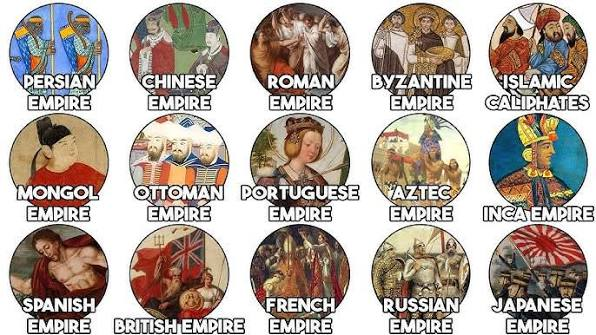
One of the earliest and most influential empires in history was the Roman Empire. It reached its peak during the 1st and 2nd centuries AD. The Roman Empire made significant contributions by building advanced systems of roads, aqueducts, and cities while developing laws that continue to influence legal systems around the world. It also played a key role in spreading Christianity throughout Europe. However, political corruption, economic difficulties, and repeated invasions by Germanic tribes eventually led to the fall of the Western Roman Empire in AD 476.
The Mongol Empire, founded by Genghis Khan in the 13th century, became the largest contiguous empire in history. It stretched from Eastern Europe to East Asia, connecting different cultures through trade and communication. The empire strengthened the Silk Road, encouraging the exchange of goods, ideas, and technologies. However, after the deaths of its great rulers, internal conflicts and the division of the empire into separate khanates weakened its power and eventually led to its decline.
The British Empire was the largest empire in modern history, controlling territories across Asia, Africa, North America, and Oceania. During the 19th and early 20th centuries, Britain dominated global trade and naval power. It also spread the English language and modern education systems to many parts of the world. After World War II, the empire gradually dissolved due to rising independence movements and economic pressures, leading to the independence of many former colonies.
Another remarkable civilization was the Ottoman Empire, which ruled parts of Europe, Asia, and Africa for more than 600 years. It became a major center of commerce, architecture, and culture while controlling important trade routes. However, military defeats, administrative problems, and growing nationalist movements gradually weakened the empire, eventually leading to its collapse after World War I.
The rise and fall of these empires demonstrate that no civilization remains powerful forever. Strong leadership, innovation, economic stability, and unity contribute to an empire’s success, while corruption, poor governance, and internal conflicts often lead to its decline.
In conclusion, the greatest empires in history have played a significant role in shaping the political, cultural, and economic foundations of the modern world. Their remarkable achievements continue to inspire historians and scholars, while their failures remind us of the importance of strong leadership, good governance, adaptability, and cooperation. Although these mighty empires eventually declined, their influence can still be seen in today’s laws, cultures, languages, and institutions. By learning from both their successes and their mistakes, we gain valuable insights into the evolution of human civilization and a deeper understanding of the world we live in today.